Learning to Make Theatre for Babies
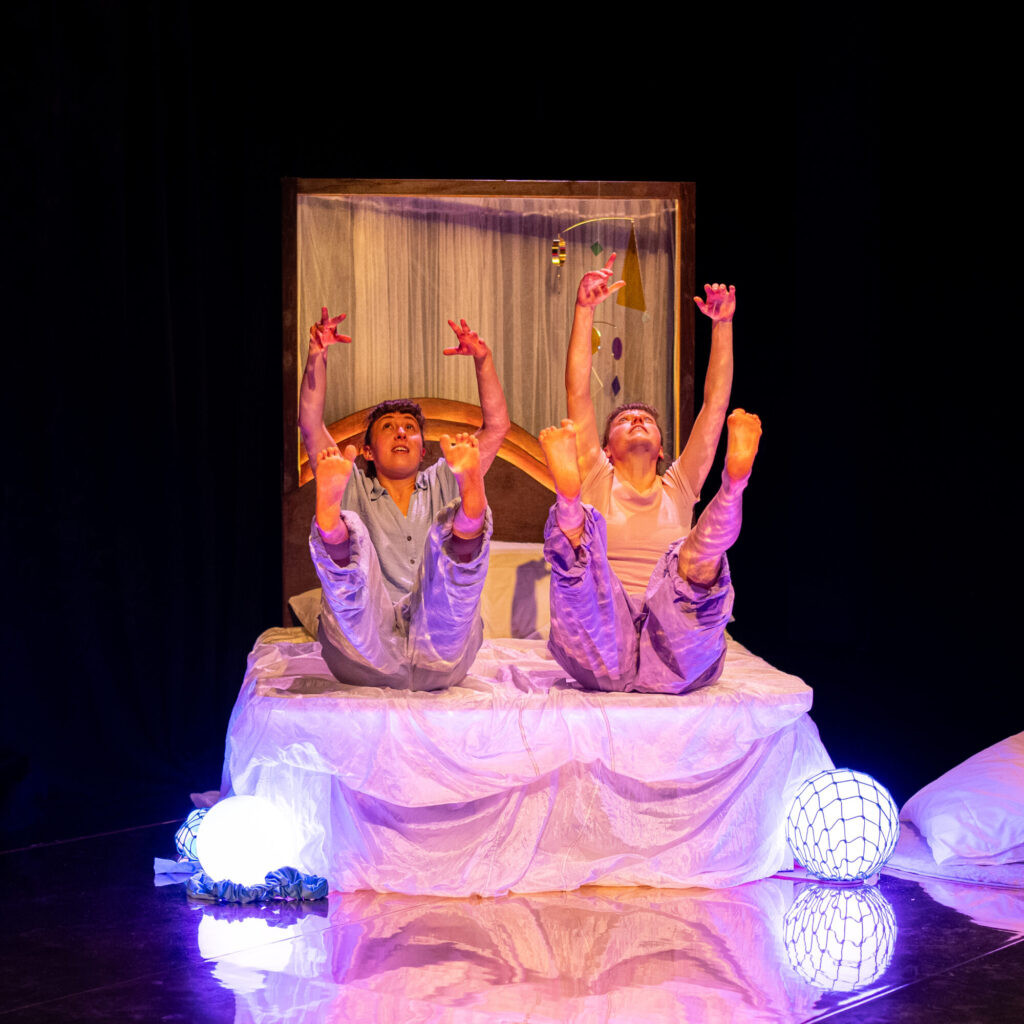
Niloo-Far Khan, ISLAND Associate Artist, reflects on shadowing Frozen Charlotte during the development of ISLAND, sharing insights into the creative process and her journey of making work for young audiences.
Where can you learn to make theatre for babies? Can you make a show for both baby and parent? Can you make a show for babies that has a story behind it? Do I feel it’s okay for me to make work for babies when I can’t and don’t want to have babies myself?
Ever since I got a taste for making a show for babies through Playfund in 2021, I have been pondering these questions and, to be quite honest, feeling a bit stuck.
Part of why these questions have lingered for me is personal. I have lived with endometriosis since I was 16 and was diagnosed with MS in 2024. Over the years there have been surgeries, medications, attempts to stop my periods and even a medically induced menopause in my late twenties. Parenthood has never felt like a straightforward possibility, nor necessarily something I want for myself. Because of that, I have often wondered whether I have the right to make work for babies and parents at all.
This year, Starcatchers connected me with Heather Fulton from Frozen Charlotte during the development of ISLAND. The opportunity gave me a chance to revisit many of the questions I have been carrying around for years. ISLAND is a show for babies from birth to 12 months and their grown-ups. It explores the unique relationship between babies and parents, navigating the push and pull of connection, dependence, care, love and separation. Through live music, movement and a rich sensory world for babies, it also creates space for adults to reflect on the joys, challenges and occasional isolation that can accompany early parenthood.
After doing a bit of research on what blogs should do (it’s been a while!), I don’t think this one will educate or answer all of those questions. What I do hope is that it encourages artists like me, who are curious about making work for babies and parents, to follow that curiosity.
Imposter Syndrome and Parenthood
I think what’s important for me to address is the imposter syndrome that comes with wanting to make a show for babies when I haven’t experienced parenthood myself.
A little of that feeling subsided when I realised that not everyone involved in making work for babies has had that experience. What is important, however, is ensuring that parents with lived experience and babies themselves are an integral part of the development process.
I have huge admiration for Starcatchers and Frozen Charlotte in the way they organised opportunities for parents and babies to engage with the work from its earliest stages. More importantly, they genuinely listened to the feedback they received.
What I often find in theatre-making more generally is that there isn’t always enough space or time factored into a process to get things wrong. Yet getting things wrong is often where the most valuable learning happens.
The times I have learned the most as an artist have often come after hitting a devastating dead end with an idea or a story, or reaching a point where I feel completely lost. Those moments force you to dig deeper and ask yourself what it is you actually want to say or make. Someone recently said to me, “You’ll find it in desperation and sweat,” and they were absolutely right. I sometimes wonder if there is a lack of transparency within our sector about the moments when things don’t go well. Failure can be uncomfortable, but it can also be an essential part of making
stronger work.
Watching ISLAND Evolve
Now, that wasn’t necessarily the experience of ISLAND – sorry for the tangent!
What I observed was a process that allowed space for shifting, changing and responding to feedback without creating panic. There were constant questions around audience comfort and safety, performer proximity to babies, how to support performers when crawlers suddenly appeared amongst them, how visual storytelling landed for both babies and adults, and where music most effectively held attention.
Because the development process was spread across several short periods over three months, these questions could be explored at a pace that felt manageable and progressive. One of the most fascinating things to witness was how babies themselves influenced the room. While adults might discuss structure or meaning, babies offered immediate and honest feedback. A change in lighting could suddenly capture every eye in the space. A piece of music could soothe a restless room within moments. Sometimes an interaction you expected to land would pass by unnoticed, while a seemingly small sensory detail would become the thing everyone wanted to explore. There is something incredibly humbling about making work for an audience that responds so instinctively.
Learning from the Team
Another way I have been battling that imposter syndrome is through education myself, not by asking my friends to lend me their babies (despite what some people might think!).
Starcatchers have made a wealth of research freely available through podcasts, practitioner interviews and resources about baby development. I’ve found these invaluable. Having the right team around a piece is crucial.
It was a real joy to watch Heather Fulton and Ruby Worth (choreographer and movement director) work together. Heather brought such warmth to the rehearsal room. She had a clear vision of the images she wanted to create and of how to tell a truthful story about the tangled relationship between care and burden, connection and separation. Ruby brought extensive knowledge of baby development alongside a grounding in somatic practice that deeply informed the devising process and the baby’s journey through the work. Together they complemented one another beautifully, creating an experience that genuinely considered both parent and child.
The process began with a devising approach, where dancers Laura and Jorja were offered stimuli and time to explore them through improvisation. The team would then come together to discuss what felt interesting, truthful or surprising within those explorations.
I cannot overstate how mesmerising it was to watch these two performers improvise. Their interactions with babies felt generous, responsive and incredibly gentle. For two performers who hadn’t previously worked directly with babies in this way, they made it look remarkably effortless.
What Babies Notice
One of the biggest surprises for me was discovering how central sound is to a baby’s experience of performance.
Rachel Newton became something of a parent-and-baby harp whisperer. Whatever she played seemed capable of soothing, engaging or encouraging a room full of people to move. Her songs and spoken-word elements created moments of calm and reflection that allowed parents to connect more deeply with the themes of the work.
I hadn’t fully appreciated how consistently babies connect with sound. It often seemed to be the strongest thread running through the performance experience.
Designer Katy Wilson brought a huge amount of knowledge around audience comfort and sensory engagement. Every design decision felt rooted in care, while still creating opportunities for exploration and wonder.
The lighting design by Michaela was equally striking. Working with pixel lights looked effortless which, in my experience, is rarely the case. The lighting helped create transitions that felt exciting, soothing and clear. And babies absolutely love light.
I had my own flashback to Little Top, where I found myself sitting at the back of the room as transfixed as the babies watching. At the end, I was invited to play with a baby who rolled a light-up ball towards me. For years I assumed the attraction was the ball itself. Watching ISLAND made me realise it was the light, the glow and the sensory experience of the object that was doing much of the work.
Transitions, I’ve learned, are everything in work for babies. Music and lighting seem to carry a huge responsibility in helping audiences move gently from one moment to the next.
What I Learned
One of the most encouraging pieces of feedback we heard from parents was that they felt seen. Another was that they hadn’t experienced their baby holding attention for such sustained periods of time.
Yet perhaps the most revealing feedback was when one parent shared that they were so focused on watching their child engage with the work that they sometimes found it difficult to look away and watch the performers. It reminded me that theatre for babies isn’t simply theatre scaled down. It is an experience shared between baby and grown-up, where both audiences are constantly observing one another.
So, do I feel it’s okay for me to make work for babies if I can’t have children myself?
Yes. Not because I suddenly have all the answers, or because I now feel completely free of imposter syndrome. I suspect that feeling will continue to appear throughout my career in one form or another. What has changed is my understanding of where good work comes from. Making theatre for babies isn’t about claiming expertise over an experience that isn’t yours. It’s about approaching that experience with curiosity, humility and care. It’s about listening deeply to the people whose lives the work touches, creating space for their voices in the room and being
willing to learn when you get things wrong.
What I witnessed throughout the development of ISLAND was a process built on exactly that. Babies, parents, performers, musicians, designers and makers all contributed something essential. No one person held all the knowledge. The work became stronger because of the conversations, questions and uncertainties that shaped it.
Perhaps the question was never, Am I allowed to make work for babies? Perhaps the better questions are:
● What experience do I want to create for babies, and why?
● What don’t I know yet?
● Who needs to be in the room?
● How can I create a process that is safe, collaborative and open to discovery?
● What support do I need to make something for the first time?
Every piece of theatre begins with questions we don’t yet know how to answer. Making work for babies is no different. What this process has reminded me is that curiosity is often more valuable than certainty. If we stay open, keep listening and surround ourselves with the right people, sometimes the work finds us before we fully understand where we’re going. And for now, that’s enough reason to keep exploring.
Photo credit: Ben Winger
-

Niloo-Far Khan
Play Fund artist
Niloo believes in stories that can offer a reflection of our current world and challenges our perceptions in positive ways that encourage us to connect nature and our belonging.